Fraser Island (K'Gari): The Backpacker's Complete Guide
G'Day Backpacker Jobs
Published 20 July 2026 · Updated 28 July 2026
Why Fraser Island belongs on every backpacker's itinerary
There are places in Australia that get talked up so much you half-expect to be disappointed when you finally arrive. Fraser Island — officially renamed K'Gari, the Butchulla word for paradise — is not one of them. The moment the barge pulls away from Rainbow Beach and the island's wall of rainforest comes into view, you understand why it makes every list.
K'Gari is the world's largest sand island. That's not a metaphor. The whole thing — 1,840 square kilometres of it — is held together by vegetation growing in sand. There's no rock anywhere. And yet inside that improbable structure there are freshwater lakes of a clarity you'd expect in a swimming pool, rainforest towering over 30 metres, ancient perched dune lakes stained the colour of strong tea, and beach that doubles as the main highway.
For backpackers doing the WHV, Fraser Island tends to land at a particular moment in the trip — usually after a stint of farm work in the Bundaberg or Bowen regions, when you've got your 88 days signed off and you're ready to actually enjoy Queensland. It's a natural reward and a good place to meet people in the same position.
Getting there from Rainbow Beach
Most independent travellers come through Rainbow Beach, about three hours north of Brisbane by bus. The Manta Ray barge runs several crossings a day from Inskip Point, just south of Rainbow Beach township. The crossing takes about ten minutes. You need a vehicle permit and a national park camping permit if staying overnight — both can be sorted online before you leave.
If you don't have a 4WD, the most practical option is to join an independent tour group departing from Rainbow Beach or Hervey Bay. These typically run over two or three days, involve hiring a 4WD between six to eight people, and cost somewhere between $160 and $230 per person including camping fees and most activities. It's social, affordable by Australian standards, and puts you in a vehicle with people in the same situation.
Lake McKenzie
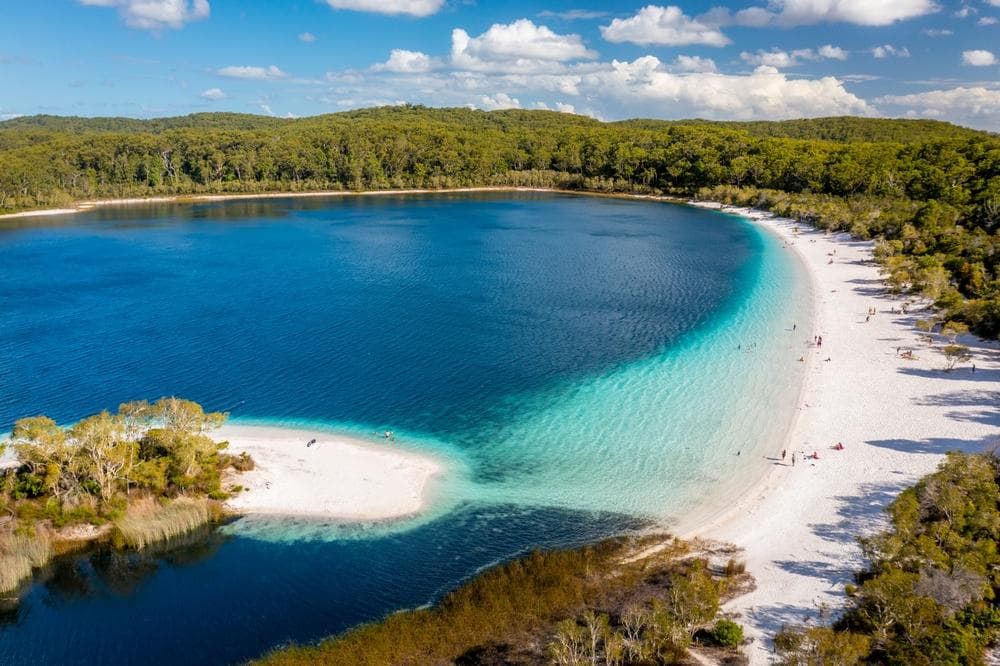
Every photograph you've seen of a lake so blue it looks synthetic is almost certainly Lake McKenzie. It's a perched lake, fed entirely by rain, which is why the water is almost entirely free of minerals and has that extraordinary translucency. The sand around it is white. The trees behind it are dark green. On a clear morning, before the tour buses arrive, it's one of the best spots in the country.
Get there early. By 10am in peak season it can be crowded; by 7am you might have it largely to yourself. If you're in a self-drive group, this is where the early start pays off.
The Maheno Wreck and Eli Creek
Seventy-Five Mile Beach has two things worth stopping for beyond the scenery. The first is Eli Creek — a fast-flowing freshwater stream that crosses the beach. Walk upstream about 400 metres through the tea-tree forest and float back down with the current. It takes about five minutes and is inexplicably satisfying.
The second is the Maheno, a passenger liner that ran aground in 1935 while being towed to Japan for scrapping. It's now a rusting skeleton half-buried in the sand, and at low tide you can walk right up to it. There's something melancholy and compelling about it that tends to stay with people.
The dingoes
K'Gari has a population of around 100 pure-strain dingoes — one of the last such populations in eastern Australia. They are genuinely wild and unpredictable, unlike anything you might encounter elsewhere in the country. The rules are simple: never feed them, never approach them, don't run if one comes close. Children must be supervised at all times near the dunes and beach edges.
In the early evening, dingoes often move along the beach looking for food. Store everything properly in the dingo-proof boxes at campsites. The national park issues fines to people who don't.
Camping on the island
The national park campsites are the way to do this properly. Central Station (in the rainforest interior), Waddy Point and Dundubara (on the eastern beach) are the main ones. All have cold showers, flushing toilets, and dingo-proof food storage. Prices are around $7–10 per person per night. Book through the NPSR website before you go — popular sites fill up weeks ahead during school holidays and Easter.
Budget and practical notes
Budget roughly $200–280 for a two-day independent 4WD tour including barge crossings, camping and activities, or $280–350 for an organised group tour from Rainbow Beach or Hervey Bay. Most backpackers find it manageable after a few weeks of farm pay in the Bundaberg region.
The Hervey Bay and Rainbow Beach areas have hostel and hospitality work for those looking to base themselves nearby before or after the island. If you're looking to extend your time in Queensland after completing your 88-day regional work, this stretch of coastline is a solid place to do it.